








Blink your blink(1) light for upcoming Google Calendar events with a keyword
Other popular blink(1) workflows and automations
-
-
-
Flash blink(1) when you post a new Facebook link
 3
3
-
-
Blink your blink(1) when Adafruit posts a new product
9
-
-
I am on the phone
25
-
-
Trigger blink(1) event from tagged email
1
-
-
Flash blink(1) when a new IFTTT update is posted
72
-
-
Trigger blink(1) light by sending an email to IFTTT
94
-
-
Flash blink(1) when a new Flickr photo is uploaded
4
-
-
Flash blink(1) when a new Dropbox file is added
39
-








Automate blink(1) and openHAB from your AI assistant
Ask ChatGPT to control your blink(1) light and create applets that flash it for anything, with IFTTT MCP.
Set up IFTTT MCP


Create your own blink(1) and openHAB workflow
Create custom workflows effortlessly by selecting triggers, queries, and actions. With IFTTT, it's simple: “If this” trigger happens, “then that” action follows. Streamline tasks and save time with automated workflows that work for you.
7 triggers, queries, and actions
Item state changes
Polling trigger
Polling Applets run after IFTTT reaches out to the trigger service and finds a new trigger event. These trigger checks occur every 5 minutes for Pro and Pro+ users, and every hour for Free users.
This Trigger fires every time an item changes its state to a value you specify.
Item state drops below
Polling trigger
Polling Applets run after IFTTT reaches out to the trigger service and finds a new trigger event. These trigger checks occur every 5 minutes for Pro and Pro+ users, and every hour for Free users.
This Trigger fires every time an item's state drops below a value you specify and works with any number item.
Item state raises above
Polling trigger
Polling Applets run after IFTTT reaches out to the trigger service and finds a new trigger event. These trigger checks occur every 5 minutes for Pro and Pro+ users, and every hour for Free users.
This Trigger fires every time an item's state raises above a value you specify and works with any number item.
History of item state changes

Query
A query lets your Applet retrieve extra data that isn't included in the trigger, so that your automation can include more complete or useful information.
This query returns a list of when an item changes its state to a value you specify.
History of item state drops below
Query
A query lets your Applet retrieve extra data that isn't included in the trigger, so that your automation can include more complete or useful information.
This query returns a list of when an item's state drops below a value you specify. Note: this query will only return future events after this Applet is created.
Send a command
Action
An action is the task your Applet carries out after the trigger occurs. It defines what happens as the result of your automation and completes the workflow.
This Action will send a command to one of your openHAB items.
Send blink event
Action
An action is the task your Applet carries out after the trigger occurs. It defines what happens as the result of your automation and completes the workflow.
This Action will send your blink(1) a new event.
History of item state changes
Query
A query lets your Applet retrieve extra data that isn't included in the trigger, so that your automation can include more complete or useful information.
This query returns a list of when an item changes its state to a value you specify.
History of item state drops below
Query
A query lets your Applet retrieve extra data that isn't included in the trigger, so that your automation can include more complete or useful information.
This query returns a list of when an item's state drops below a value you specify. Note: this query will only return future events after this Applet is created.
Item state changes
Polling trigger
Polling Applets run after IFTTT reaches out to the trigger service and finds a new trigger event. These trigger checks occur every 5 minutes for Pro and Pro+ users, and every hour for Free users.
This Trigger fires every time an item changes its state to a value you specify.
Item state drops below
Polling trigger
Polling Applets run after IFTTT reaches out to the trigger service and finds a new trigger event. These trigger checks occur every 5 minutes for Pro and Pro+ users, and every hour for Free users.
This Trigger fires every time an item's state drops below a value you specify and works with any number item.
Item state raises above
Polling trigger
Polling Applets run after IFTTT reaches out to the trigger service and finds a new trigger event. These trigger checks occur every 5 minutes for Pro and Pro+ users, and every hour for Free users.
This Trigger fires every time an item's state raises above a value you specify and works with any number item.
Send a command
Action
An action is the task your Applet carries out after the trigger occurs. It defines what happens as the result of your automation and completes the workflow.
This Action will send a command to one of your openHAB items.
Send blink event
Action
An action is the task your Applet carries out after the trigger occurs. It defines what happens as the result of your automation and completes the workflow.
This Action will send your blink(1) a new event.
Build an automation in seconds!
If

Select a trigger the automation will use
Item state changes
Item state drops below
Item state raises above
Then
Select an action the automation will perform
Send a command
 Send blink event
You can add delays, queries, and more actions in the chat.
GET STARTED
How to connect to a blink(1) automation
Find an Applet using blink(1) and openHAB
Find an automation to connect to, or create your own!Connect IFTTT to your accounts
Securely connect the Applet services to your respective accounts.Finalize and customize your Applet
Review trigger and action settings, and click connect. Simple as that!Make more happen with your credits
-
More credits, more possibilities
Get more credits per month to power more automation activity. -
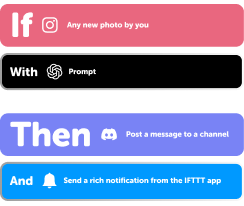
Power more advanced automations
Use credits to power your automations, including actions that require more processing. -
Access faster speeds and higher rate limits
Get faster updates and more actions with increased rate limits and more frequent checks.
blink(1) and openHAB tips, tools, and resources


More on blink(1) and openHAB
About blink(1)
blink(1) and IFTTT let you light up a USB notification device to alert you when anything happens online.
About openHAB
openHAB and IFTTT let you trigger automations when your smart home devices change state, then send commands to control them.